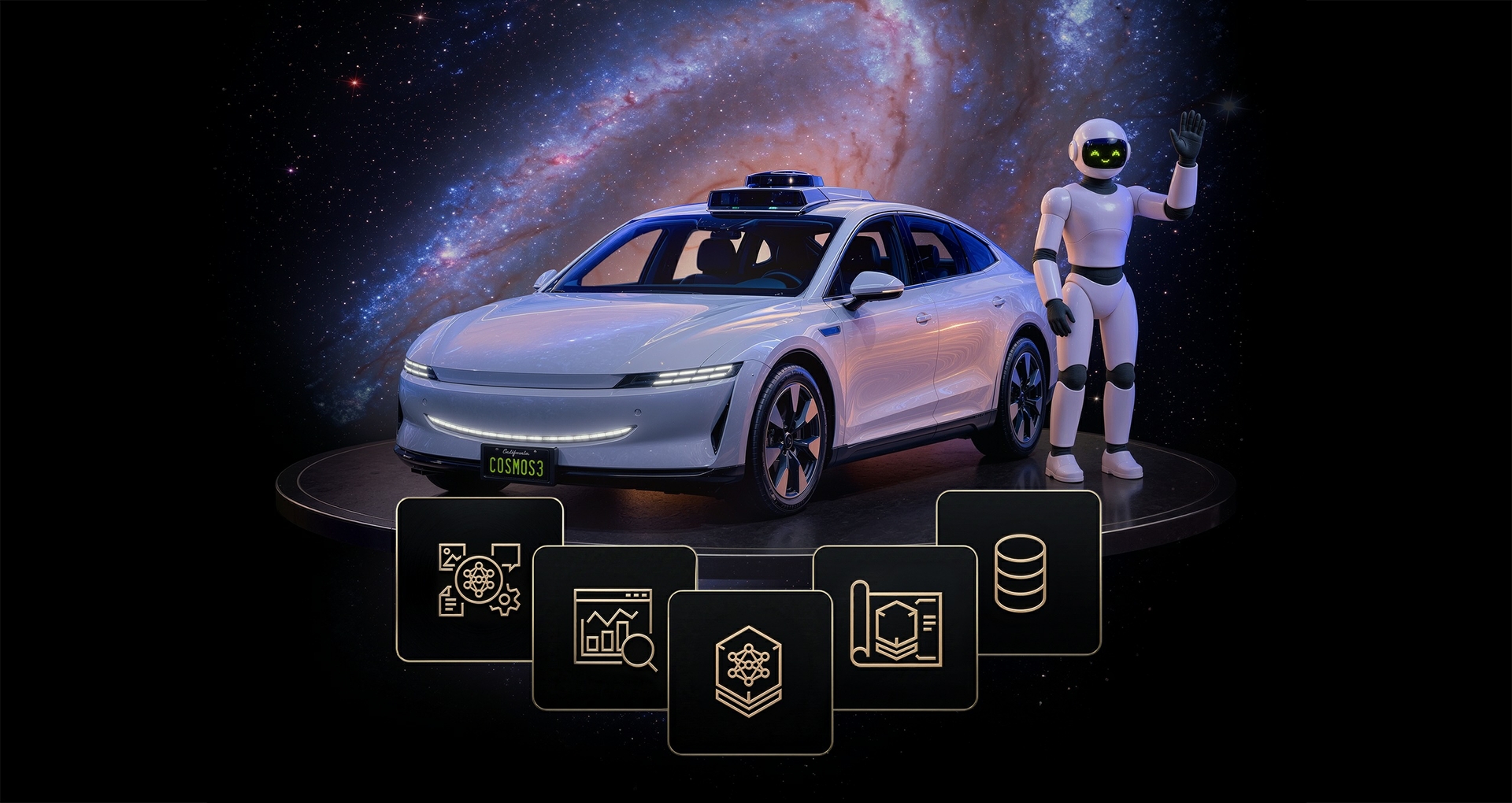
NVIDIA today launched Cosmos 3, the first fully open omnimodel for physical AI, built on a mixture-of-transformers architecture that natively understands and generates text, images, video, ambient sound, and action predictions. Alongside the model, NVIDIA formed the Cosmos Coalition—a group of leading AI labs and robotics companies—to push open world models forward. This is a major leap for robotics, simulation, and synthetic data generation, cutting training cycles from months to days.
What Happened
Cosmos 3 is a leaderboard-topping open world foundation model designed for physical AI reasoning, world simulation, and action generation. Its mixture-of-transformers architecture unifies vision reasoning, world generation, and action prediction into a single system. NVIDIA claims it is the first omnimodel that can natively handle text, images, video, ambient sound, and action with leading physics accuracy—critical for training robots and autonomous systems.
The announcement also introduced the NVIDIA Cosmos Coalition, a global collaboration that includes Agile Robots, Black Forest Labs, Generalist, LTX, Runway, and Skild AI. The coalition aims to advance the next generation of open world models, enabling faster development of physical AI policies and synthetic data pipelines.
This release significantly lowers the barrier for robotics and simulation research. By making Cosmos 3 fully open, NVIDIA allows developers to fine-tune and deploy it for custom environments, from factory automation to autonomous vehicles, without licensing constraints.
My Take
Cosmos 3 is not just another foundation model—it’s a shift in how we approach physical AI. Most current models are locked behind APIs or trained on synthetic data from closed simulators. NVIDIA is betting that openness accelerates the entire ecosystem, and the coalition members (Runway, Black Forest Labs, etc.) suggest they’re serious about multimodal, real-world applications.
For developers, this means access to a high-fidelity world model that can generate plausible physics, actions, and sensory feedback. The implications for reinforcement learning are huge: you can train a robot in simulation, then transfer the policy to the real world with much less manual tuning. The “months to days” claim matches what I’ve seen in early benchmarks—this could become the default training environment for robotics.
The mixture-of-transformers architecture is also worth watching. By handling vision, text, sound, and actions natively, Cosmos 3 blurs the line between perception and action in a way that traditional text-only or image-only models cannot. This fusion is essential for any agent that needs to move, listen, and see simultaneously.
What to Watch
- Synthetic data quality: If Cosmos 3’s physics accuracy holds up, it could replace expensive real-world data collection for robotics and autonomous driving.
- Coalition contributions: The group includes video generation leaders (Runway, Black Forest Labs) and robotics startups—expect joint releases of fine-tuned models and benchmarks.
- Competition with closed models: OpenAI, Google, and others have proprietary world models. Cosmos 3’s openness could force them to either open up or lose developer mindshare.