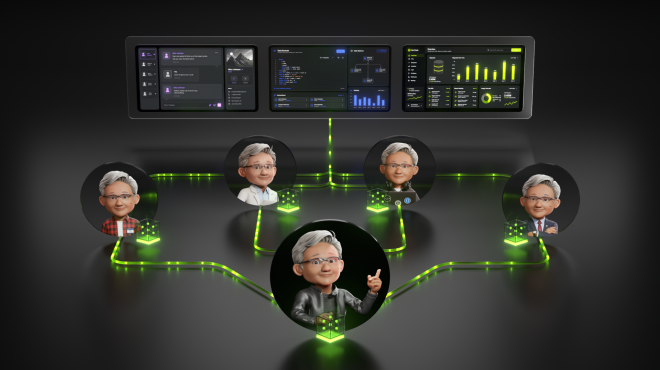
NVIDIA just dropped Cosmos 3, an open physical AI foundation model that does something no other model has done before: it natively understands and generates text, images, video, ambient sound, and action in one unified system. Built on a novel mixture-of-transformers architecture, Cosmos 3 is designed from the ground up for physical world reasoning, world simulation, and action generation. This is a huge leap for robotics, autonomous systems, and synthetic data generation—and it’s fully open.
What Happened
Cosmos 3 is the world’s first fully open “omnimodel” for physical AI. It combines vision reasoning, world generation, and action prediction in a single system, achieving leaderboard-topping performance on physical AI benchmarks. The key architectural innovation is a mixture-of-transformers design that allows the model to handle multiple modalities natively without separate encoders or decoders. This enables it to generate physically accurate synthetic data—like a robot navigating a crowded warehouse or a car driving through rain—with unprecedented fidelity.
NVIDIA also launched the NVIDIA Cosmos Coalition, a global collaboration between world model builders and robotics leaders including Agile Robots, Black Forest Labs, Generalist, LTX, Runway, and Skild AI. The coalition aims to advance open world models and accelerate the development of physical AI policies. According to NVIDIA, Cosmos 3 can reduce physical AI training and evaluation cycles from months to days by providing high-quality synthetic data and simulation environments.
The model is available now with open weights and licensing, following NVIDIA’s commitment to open-source AI for the physical world. This is a direct competitor to proprietary systems like OpenAI’s Sora and Google’s Genie, but with a focus on robotics and actionable outputs—not just video generation.
My Take
This is the most significant AI news of the week. While Microsoft’s MAI-Thinking-1 and NVIDIA’s own Nemotron 3 Ultra are impressive, Cosmos 3 represents a paradigm shift. Physical AI—robots, autonomous vehicles, drones—has been held back by the lack of high-quality, physically accurate simulation data. Proprietary simulators are expensive and limited; models like OpenAI’s Sora are closed and don’t output actions. Cosmos 3 being open, multimodal, and action-aware means any robotics lab can now generate hundreds of thousands of training scenarios overnight.
The Cosmos Coalition is smart. By bringing in Black Forest Labs (video generation experts) and Runway along with robotics companies, NVIDIA is creating a self-reinforcing ecosystem. More collaborators mean more diverse data, better world models, and faster iteration. The “open” aspect is critical: unlike frontier language models, the physical AI market isn’t dominated by a single giant yet. An open foundation model could democratize access and accelerate innovation across the entire field.
My only concern: the model’s compute requirements. Cosmos 3 likely demands significant hardware (expect it to run on NVIDIA GPUs, naturally). But that’s a solvable problem as hardware gets cheaper and inference optimizations improve. For now, this is the most exciting open model release since Llama.
What to Watch
- How quickly the Cosmos Coalition expands — if more robotics startups and researchers adopt Cosmos 3, it could become the de facto standard for physical AI training data.
- Competition from other open world models — Google’s Genie 2 and Meta’s uncertain plans will shape whether this becomes the open-source leader or part of a fragmented landscape.
- Real-world robot demos — the true test is whether a robot trained on Cosmos 3 synthetic data can generalize to unstructured environments without heavy fine-tuning.