Unisound just dropped U2, a new general-purpose large language model that flips the script on what LLMs are supposed to do. Instead of optimizing for chat or single-turn Q&A, U2 is built from the ground up as a native agentic model—designed to autonomously decompose and execute complex, real-world workflows spanning 100+ steps. This isn’t another chatbot; it’s an execution engine.
The shift from “providing answers” to “getting work done” is the kind of practical leap the industry has been promising for years. U2 might be the first model that actually delivers on that promise at scale.
What Happened
On June 8, 2026, Unisound officially released U2, its next-generation general-purpose large language model. The company positions U2 as a “native agentic large model” built for individuals, developers, and organizations. Its core technical proposition is simple: high intelligence density × high Token value. Rather than stacking parameters or competing on output length, U2 aims to use fewer activated resources while delivering results that are closer to a finished deliverable.
U2 excels in complex office work, software engineering, deep research, and multi-tool collaboration scenarios. It can autonomously decompose and advance workflows of over 100 steps, connecting requirement understanding, task planning, environment interaction, tool use, process correction, and result validation into a complete execution loop. This moves beyond traditional LLMs that are oriented toward single-turn Q&A or short-chain generation.
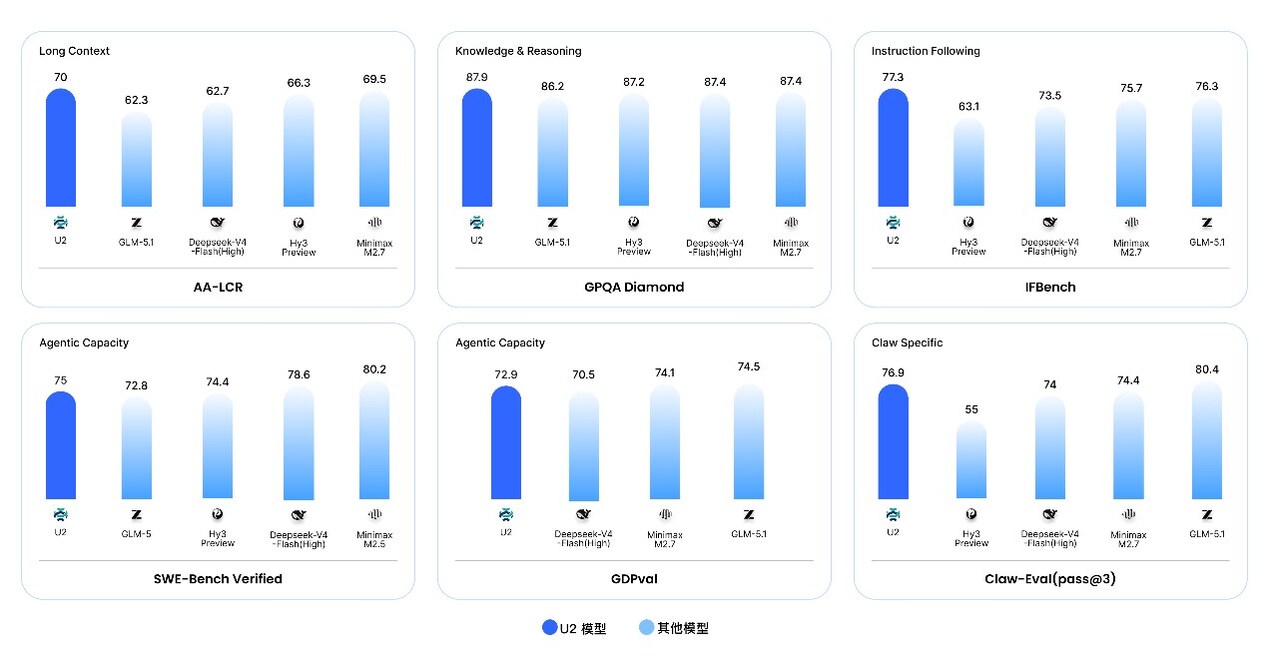
The model has already demonstrated top-tier performance in authoritative evaluations, though specific benchmark scores were not detailed in the announcement. Unisound is positioning U2 as a direct competitor to models from OpenAI, Anthropic, and Google, but with a sharper focus on execution rather than conversation.
My Take
This is the kind of release that makes you stop and pay attention. Most LLM announcements are about incremental improvements in benchmark scores or context windows. U2 is different—it’s a fundamental rethinking of what the model is supposed to do. Instead of being a smart autocomplete, it’s designed to be a worker. That distinction matters.
For developers, this means the era of stitching together chains of prompts and custom tool integrations might be coming to an end. If U2 can genuinely handle 100+ step workflows autonomously, it reduces the need for brittle orchestration layers. You give it a goal, and it figures out the rest. That’s a massive productivity shift, but it also raises questions about debugging and observability—how do you audit a model that’s been running autonomously for 100 steps?
The “high intelligence density” angle is also worth watching. If Unisound has genuinely found a way to pack more capability into fewer parameters, that could make U2 cheaper to run and faster to respond than comparably capable models. That’s a direct threat to the current pricing models of OpenAI and Anthropic.
What to Watch
- Enterprise adoption velocity: If U2 can reliably handle complex office workflows, expect rapid adoption in finance, legal, and operations teams that are drowning in multi-step processes.
- Debugging and observability tools: Autonomous 100-step execution is powerful, but opaque. Watch for Unisound or third parties to release tooling that lets developers inspect and replay agent decisions.
- Competitive response from OpenAI and Anthropic: Both companies have agentic features in development, but U2 is the first purpose-built native agentic model. Their next releases will likely accelerate their own agentic roadmaps.