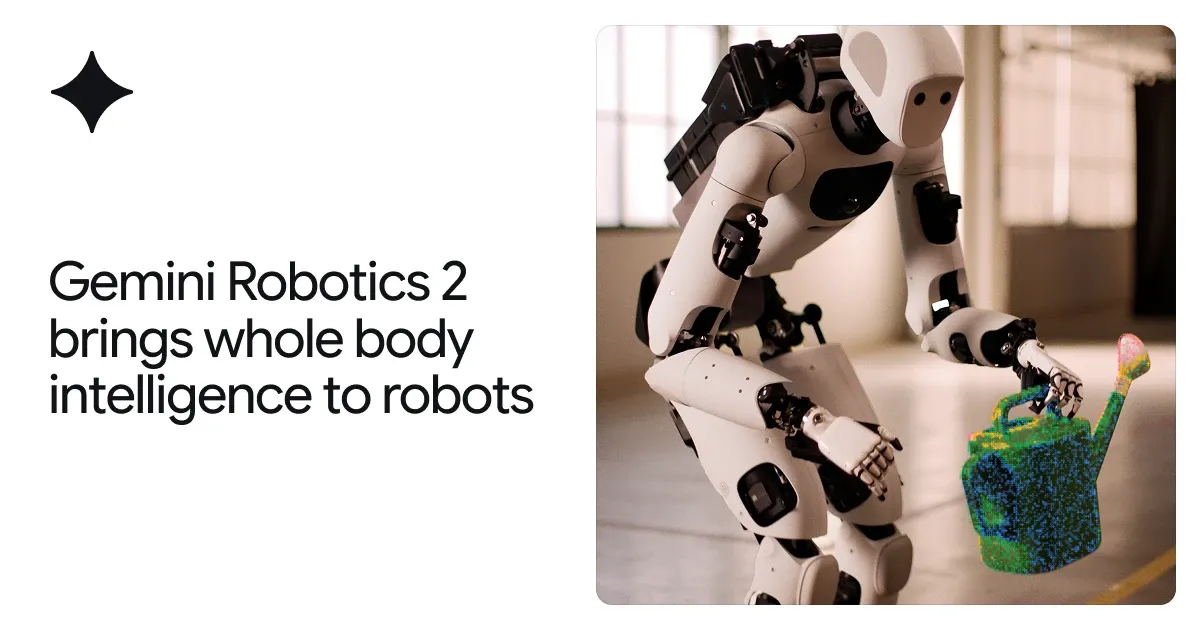
Google DeepMind has unveiled Gemini Robotics 2, a major leap in AI-driven robotics that gives robots intelligent whole-body control, fine dexterity, and the ability to collaborate with other robots. This release builds on Gemini’s multimodal understanding to drive real-world action, moving beyond pre-programmed or teleoperated robots toward truly adaptable machines that can learn and adapt to unpredictable environments.
The announcement marks a significant shift from narrow, repetitive task sequences to robots that can reason through every movement, from fingertips to whole-body coordination, enabling them to handle a broad range of complex tasks.
What Happened
On July 30, 2026, Google DeepMind introduced Gemini Robotics 2 as the intelligence layer for next-generation adaptable robots. The model enables robots to reason through every movement, unlocking intelligent whole-body control, advanced dexterity, and multi-robot collaboration. This is a direct upgrade from the original Gemini Robotics, which demonstrated how Gemini’s multimodal understanding could drive real-world action.
The key innovation is that robots can now think, act, and interact intelligently to safely complete tasks in unpredictable environments. Unlike traditional robots that rely on pre-programmed sequences or teleoperation, Gemini Robotics 2 allows robots to learn and transfer skills across different robot bodies — a notoriously difficult challenge in robotics.
My Take
This is the most significant robotics AI advancement this year. Whole-body intelligence isn’t just a flashy feature — it’s the missing piece that makes robots useful outside of controlled factory floors. The ability to coordinate from fingertips to feet means robots can now navigate cluttered homes, assist in surgeries, or work alongside humans in dynamic environments without crashing into things or dropping objects.
For developers, the real story here is the multimodal reasoning backbone. Gemini Robotics 2 doesn’t just control motors; it understands context through vision, language, and spatial reasoning. This opens the door to building applications where robots can interpret natural commands like “grab the red cup from the counter and hand it to me” — and actually execute the full sequence reliably. The multi-robot collaboration feature is a bonus that hints at coordinated swarms working in warehouses or disaster response.
What to Watch
- Skill transfer across robot bodies — If Google DeepMind cracks this, we’ll see a single AI model power everything from humanoids to drones, massively reducing development costs.
- Safety and real-time adaptation — The ability to track progress and adapt mid-task is critical for deployment in homes and hospitals; watch for independent safety benchmarks.
- Competitive pressure on other robotics labs — Tesla Optimus, Figure AI, and Boston Dynamics will need to respond quickly or risk falling behind in the AI-driven robotics race.