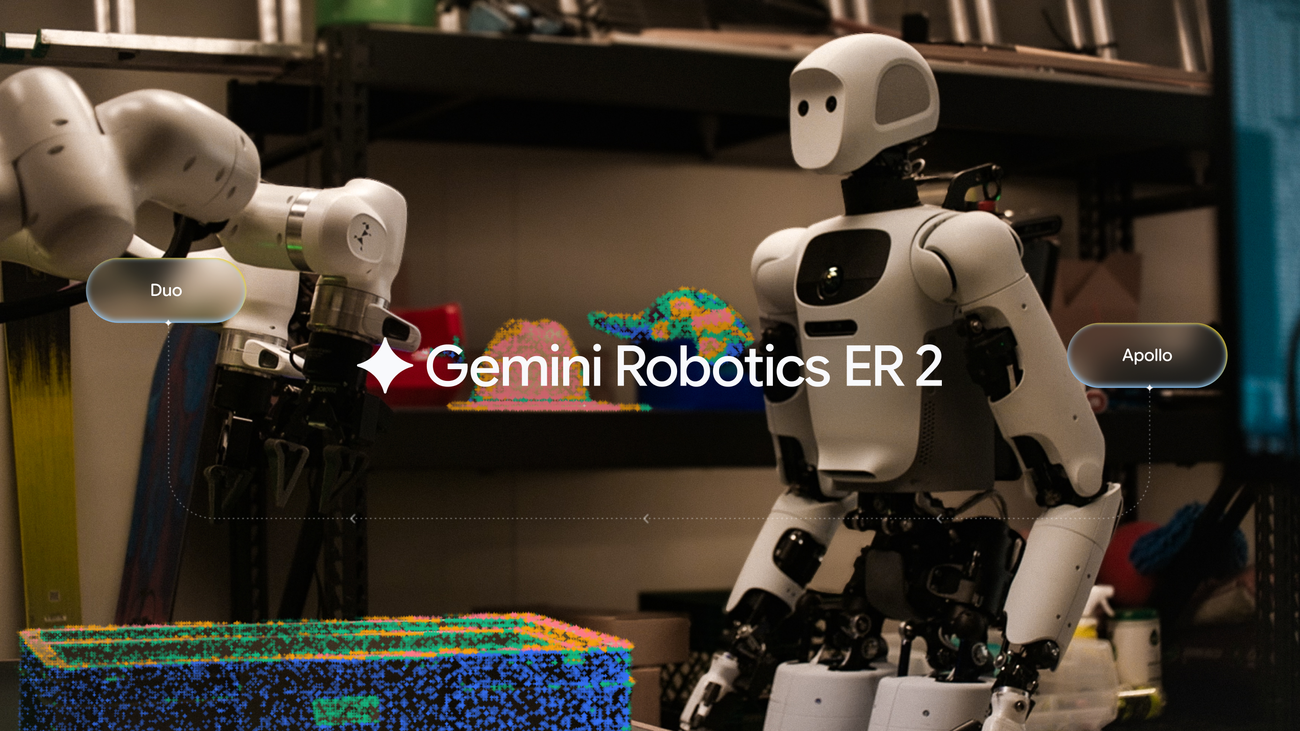
Google DeepMind has unveiled Gemini Robotics ER 2, its most capable “embodied reasoning” model for robotics, alongside a broader Gemini Robotics 2 suite that includes full humanoid body control. The new model lets robots think and act simultaneously, tracking their own progress through video feeds, adapting to failures in real time, and orchestrating multi-step tasks across multiple robots. This isn’t just an incremental update — it’s a fundamental shift in how robots can operate in unstructured human environments.
What Happened
Gemini Robotics ER 2 is designed as a “high-level brain” for robots. It can chat with humans, understand physical spaces, plan multi-step tasks, and — critically — hand off motor execution to lower-level vision-language-action (VLA) models. The model natively calls tools like Google Search or user-defined functions, and it can “think” about next steps while simultaneously performing current actions, eliminating the serial bottleneck that plagued earlier robotic reasoning systems.
The upgrade over ER 1.6 is substantial. By continuously watching video feeds, ER 2 can track its own progress, detect when something goes wrong mid-task, and decide when to move on — rather than following a rigid, pre-programmed plan. This brings robots closer to how humans handle uncertainty: observing, reasoning, and adapting on the fly.
Alongside ER 2, the full Gemini Robotics 2 suite includes two additional models: a standard VLA model and On-Device 2, an edge-based variant running locally on robot hardware. For the first time, the VLA family extends beyond upper-body control — Gemini Robotics 2 coordinates legs, torso, arms, and fingers under a single learned policy. It’s been demonstrated on Apptronik’s Apollo 2 humanoid with both Sharpa and Inspire five-fingered hands, plus a two-armed Franka Duo and several research platforms. Apptronik’s Robot Park, a nearly 90,000-square-foot data collection facility in Austin, is already feeding the training pipeline.
My Take
The simultaneous think-and-act capability is the real story here. Most robotics systems operate in separate phases — perceive, plan, then execute — which makes them slow and brittle in unstructured environments. ER 2 collapses that pipeline. The fact that it can watch its own video feed and course-correct mid-task is the difference between a robot that works in a controlled lab and one that can actually help in a kitchen or hospital.
For developers, the tool-calling integration with Google Search is quietly significant. It means robots aren’t limited to what’s encoded in their weights — they can fetch fresh information and act on it. That’s a design pattern worth studying if you’re building on top of these models.
That said, don’t overlook On-Device 2. The edge variant addresses the latency and privacy concerns that have kept robots out of sensitive environments. If a roboticist can run a capable model on local hardware without cloud dependencies, deployment costs drop dramatically and reliability improves in areas with poor connectivity.
What to Watch
- Whole-body coordination: Full humanoid control across feet-to-fingertips under a single policy is a first for the Gemini family — expect competitors to scramble to match this.
- Multi-robot orchestration: ER 2’s ability to coordinate teams of robots could unlock warehouse and logistics scenarios where single-robot autonomy was previously the ceiling.
- Apptronik’s Robot Park pipeline: That 90,000-square-foot facility is a data flywheel — the more real-world interactions Gemini Robotics 2 sees, the faster it improves.
- Open-weight rivalry: With Moonshot AI’s Kimi K3 hitting 2.8T open parameters on the same day, the AI race now spans both language and physical domains.