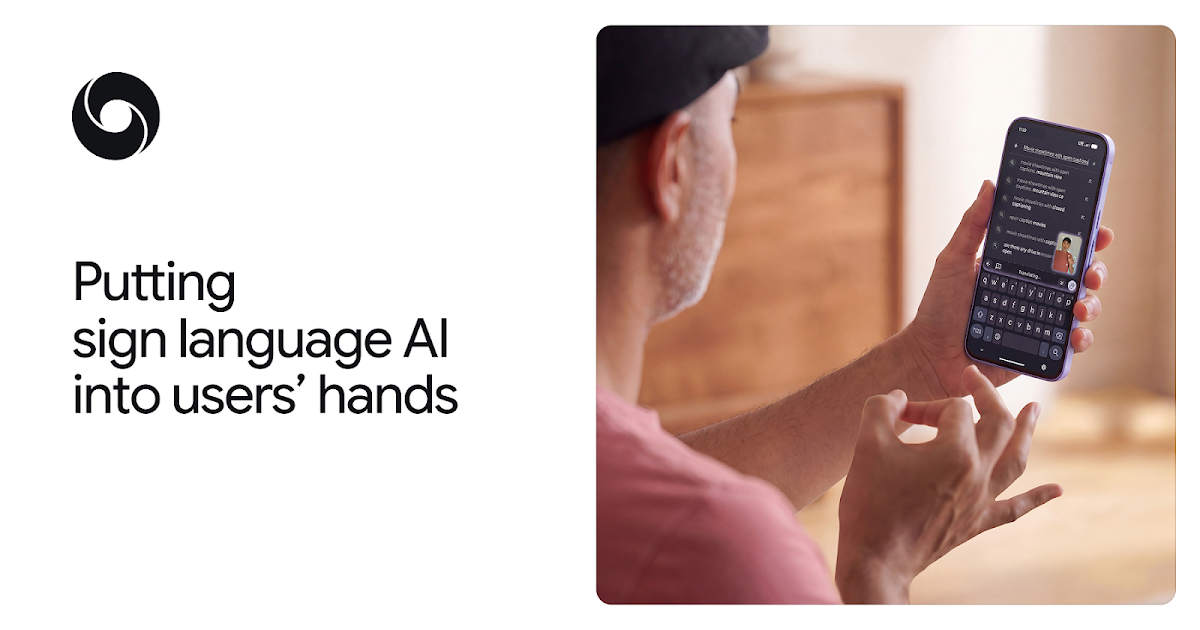
For the 70 million Deaf and hard of hearing people who use sign languages, voice dictation has always been a one-way street. That changed this week. Google DeepMind launched SL2T, a massively multilingual sign-language-to-text model, and is shipping it in consumer products for the first time—starting with American Sign Language (ASL) to English on Pixel 11 devices.
This is not a research demo. SL2T powers sign-to-text dictation in Gboard and Live Transcribe, letting users sign to search the web, draft messages, or command Gemini hands-free. It’s the first real bridge between sign languages and the AI tools hearing users take for granted.
What Happened
DeepMind’s Sign Language Team introduced SL2T (sign-language-to-text) as a breakthrough in quality and generality. The model supports over 200 sign languages, though initial consumer rollout is ASL-to-English only, with more languages promised.
The integration hits two Google products on Pixel 11: Gboard (for typing, searching, and interacting with Gemini) and Live Transcribe (for signing responses mid-conversation instead of typing back). Rather than requiring special hardware, the feature works on the phone camera in real time—similar to how voice dictation uses the microphone.
DeepMind emphasized that this is the first time sign language AI has been made available directly in consumer products, not just academic benchmarks or controlled demos. The team trained on large-scale ASL data and used advances in video understanding to handle the nuance of hand shapes, facial expressions, and body movements that carry linguistic meaning.
My Take
This is the kind of AI milestone that actually redefines who technology serves. For years, voice-first interfaces have excluded Deaf users from the convenience of dictation. SL2T doesn’t just add a feature—it flips the power dynamic. Now a Deaf person can sign a search query as naturally as a hearing person speaks it.
The choice to start with Gboard and Live Transcribe is smart. Those are daily-use tools, not niche assistive apps. That suggests Google is serious about making sign language input a first-class citizen in its ecosystem. The challenge ahead is scaling beyond ASL; the world’s 200+ sign languages are linguistically distinct, and building equivalent models for each will require massive data collection and community partnerships.
From a developer perspective, this is also a signal that real-time video understanding is production-ready on mobile devices. The same techniques could unlock other gesture-based interfaces, but the immediate impact on accessibility is what matters most.
What to Watch
- Language expansion timeline: SL2T claims multilingual support, but only ASL is live. Watch for when BSL, LSF, and other major sign languages roll out and whether Google invests in parallel data pipelines.
- Accuracy and latency in the wild: Live sign-to-text dictation must handle variable lighting, background motion, and signing speed. Early user reports on Pixel 11 will set expectations for the entire category.
- Competitive response: Apple and Samsung have accessibility teams working on sign language recognition. Expect rapid catch-up, but Google’s head start with a deployed model could cement Gboard as the default sign-input keyboard.