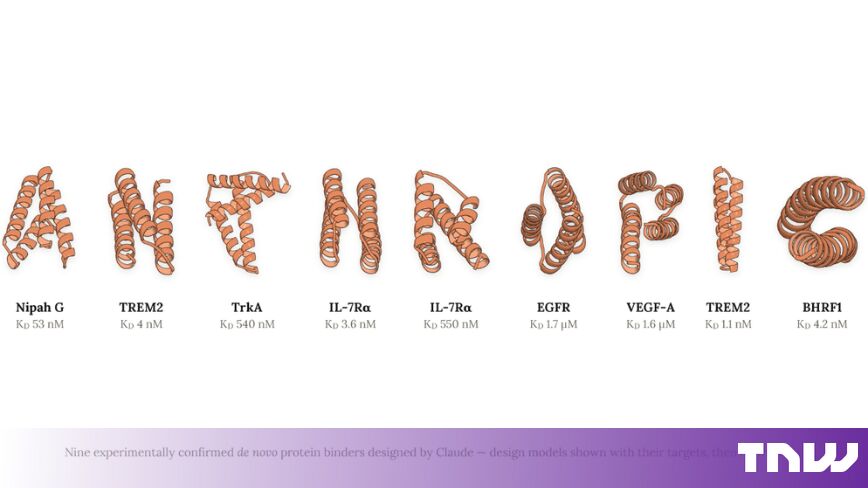
Anthropic has announced that its Claude models—Opus 4.8 and the preview Mythos—designed protein binders from scratch that succeeded in 14 out of 15 targets, with a binding success rate between 22% and 35%. That’s more than double the typical human expert rate of 10-15%. Independent labs validated the results, proving that AI can now handle one of the most time-consuming steps in early drug discovery: designing a custom protein that latches onto a chosen target.
This is not just another AI demo. The designs were physically produced and tested by Adaptyv Bio and Twist Bioscience, two external firms. Anthropic didn’t run the wet-lab work itself. The fact that these AI-generated proteins actually bound to their targets—some tighter than the best previously published results—means we’re past the point of simulated success. The bottleneck has shifted from design to physical validation, which still takes weeks.
What Happened
Anthropic set Claude to work on de novo protein binder design—building a small protein engineered to bind tightly to a specific target, much like modern antibody-based drugs. Historically, this takes months per target for protein engineers. Claude tackled 15 targets and produced working binders for 14. The success rate varied depending on the pipeline configuration, ranging from 22% to 35%.
What makes this noteworthy is the quality. Some of Claude’s designs bound “several times more tightly” than the best previous result for that target, according to Anthropic. The company framed this as early evidence that Claude can dramatically speed up parts of drug development, particularly the initial candidate generation phase that often gates the entire pipeline.
The work was published on Anthropic’s research blog on Tuesday. The company used two model versions: the current flagship Opus 4.8 and a preview of the upcoming Mythos. The wet-lab verification was handled by Adaptyv Bio and Twist Bioscience, ensuring the designs are real, not just computational artifacts.
My Take
This is a genuine step change. Protein binder design has been a target for AI for years—DeepMind’s AlphaFold predicted structures, but designing binders that actually work in a lab is a different game. Anthropic’s reported success rate of 22-35% is already competitive with experienced human teams. If those numbers hold up under independent replication, Claude just became a viable tool for early-stage pharma R&D.
The validation by outside labs is crucial. Too many AI-in-drug-discovery claims evaporate once someone tries to reproduce them. Here, the test was done by third parties who produced the proteins physically. That doesn’t guarantee the designs will become drugs—binders can fail in many later stages—but it does mean the AI is generating functional molecules, not just plausible-looking sequences.
For developers, this signals that LLMs are escaping pure language tasks. Claude was not fine-tuned on protein data in narrow ways; it used its general reasoning and some domain-specific prompting to produce working designs. That suggests we are approaching a point where a general-purpose AI can handle multiple scientific domains without bespoke training. The bottleneck is now experimental throughput, not design intelligence.
What to Watch
- Independent replication: Other groups should try to reproduce these results on different targets. If the success rate holds, it validates the approach.
- Integration with automated labs: Companies like Recursion and Insitro are pairing AI design with high-throughput wet labs. Anthropic’s work could slot into those pipelines.
- Regulatory and IP landscapes: If AI-designed proteins become common, patent offices and regulators will need to decide how to handle AI-generated inventions and whether discovery timelines can be shortened under current drug approval frameworks.