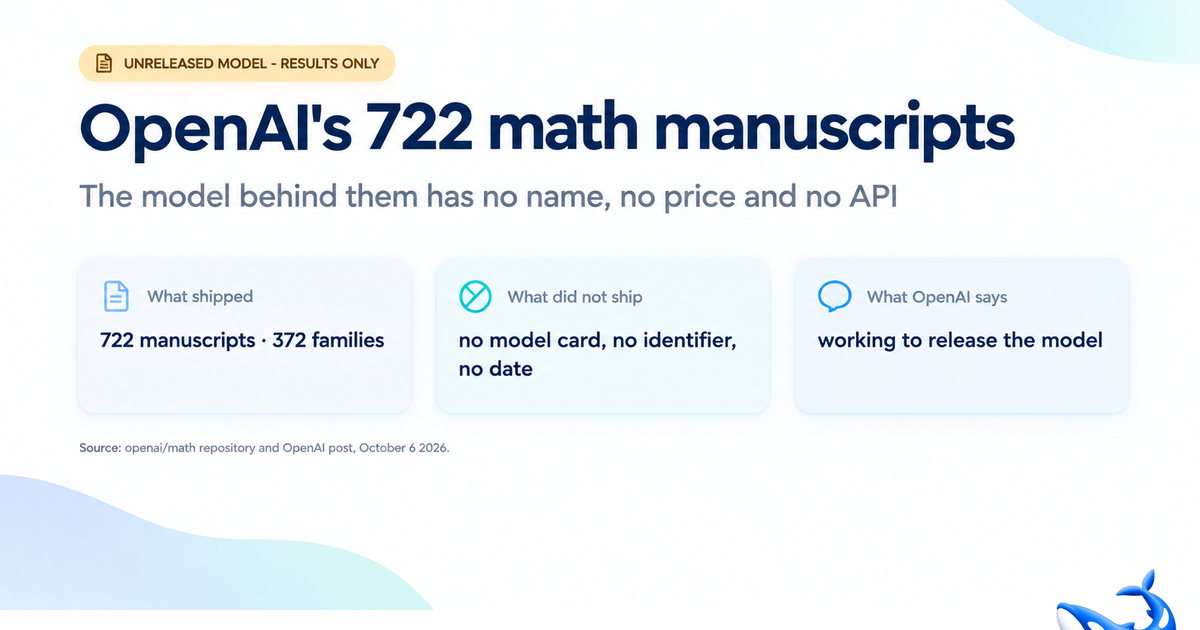
On October 6, 2026, OpenAI quietly uploaded a GitHub repository containing 722 mathematical manuscripts—all produced by an internal frontier model that has no name, no price, and no public API. The move is unlike anything the AI industry has seen: a research lab releasing thousands of AI-generated proofs for some of the hardest open problems in mathematics, including the quasi-Riemann hypothesis, the Unique Games Conjecture, and the Hodge conjecture for CM abelian varieties. We might be witnessing the beginning of the math singularity.
What Happened
At 21:47 UTC, a GitHub repository called openai/math appeared with no description and a single commit. Fourteen minutes later, OpenAI posted the project on X and launched a companion page titled “Sharing AI progress in mathematics.” The content: 722 manuscripts grouped into 372 families, selected from an evaluation of roughly 4,000 open problems. Each manuscript took an average of three hours of ChatGPT Pro‑level thinking compute from the unreleased internal model.
OpenAI CEO Sam Altman personally highlighted four results as the biggest claims: a proof of the quasi-Riemann hypothesis, a proof of the Unique Games Conjecture, a proof of the Hodge conjecture for CM abelian varieties, and a resolution of the free group factors problem. The first, second, and fourth have been formalized in Lean—meaning a computer has verified the logical structure. The Hodge result currently lacks a formalization.
Critically, OpenAI stresses that this is not a model launch. No model card, no identifier, no context window, no benchmark table, and no pricing. The model that wrote these papers is still being actively trained. The company says it is working on “responsibly releasing” it. For now, all results are unpeer-reviewed, and OpenAI explicitly warns that findings without Lean formalization “could have issues.”
My Take
This is the most consequential research release from OpenAI since GPT‑4. The decision to publish thousands of AI-generated proofs without naming the model is a deliberate signal: the frontier is moving faster than even the company can keep up with. By releasing the manuscripts now, they are inviting the mathematical community to verify, critique, and contribute before the model is productized.
For developers, the takeaway is twofold. First, LLM-powered reasoning is now capable of producing publishable mathematical work. The combination of natural-language reasoning with Lean verification creates a powerful new workflow for research. Second, the lack of a formalized Hodge proof reminds us that AI is still fallible in areas beyond formal verification. Every unverified result should be treated as a conjecture, not a theorem.
The most interesting angle is what this means for the rest of the AI industry. Google DeepMind, Anthropic, and others are surely racing to replicate this capability. The economic value of a model that can autonomously generate novel theorems is enormous—entire fields of mathematics could be automated within a decade.
What to Watch
- Verification timeline: How quickly the mathematical community reviews and validates (or refutes) the quasi-Riemann hypothesis proof. This will set the precedent for trust in AI-generated mathematics.
- Model release: Whether OpenAI eventually opens an API or pricing for the unnamed model, and whether it will be called something like GPT‑7.
- Impact on open problems: The remaining 3,628 unsolved problems from the initial pool are still unexplored. If the model keeps running, we could see a flood of new results in the coming weeks.